Happy New Year with the Flammarion engraving

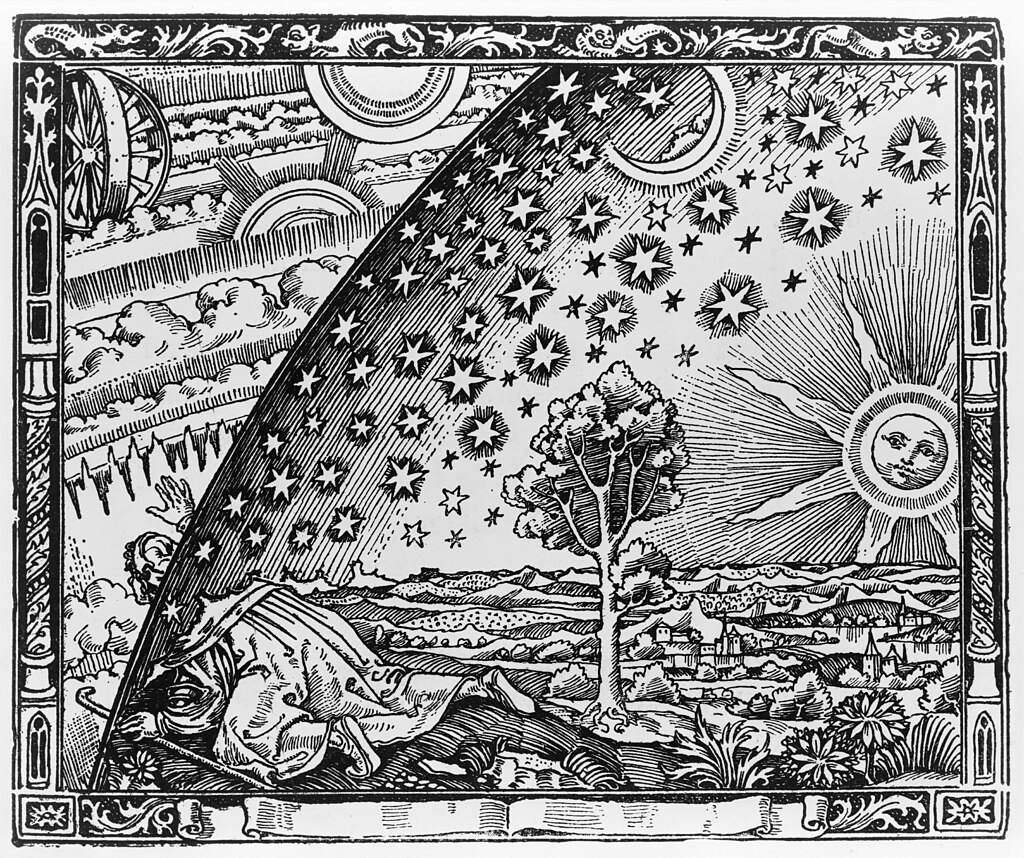
I have always been deeply fascinated by these kinds of images, ever since I was a child. The traveler peers through the horizon but the sun doesn’t look happy. (Image taken from Wikipedia.)

In wandering steps, the traveler strides to see,
Beyond the horizon where dreams take flight,
Yet the sun, veiled in clouds, seems not to be
In joyous mood, its radiance held tight.

The traveler peers, seeking sights anew,
A vista vast, a world of untold tales,
Yet the sun’s visage wears a somber hue,
As if its glow in sorrow gently pales.

What secrets lie where the horizons blend,
What tales untold in shadows cast askew,
The traveler’s heart with wonder starts to bend,
As sun and sky share their melancholy view.

Oh, traveler, amidst this sun’s saddened gleam,
Find beauty still in every distant dream.

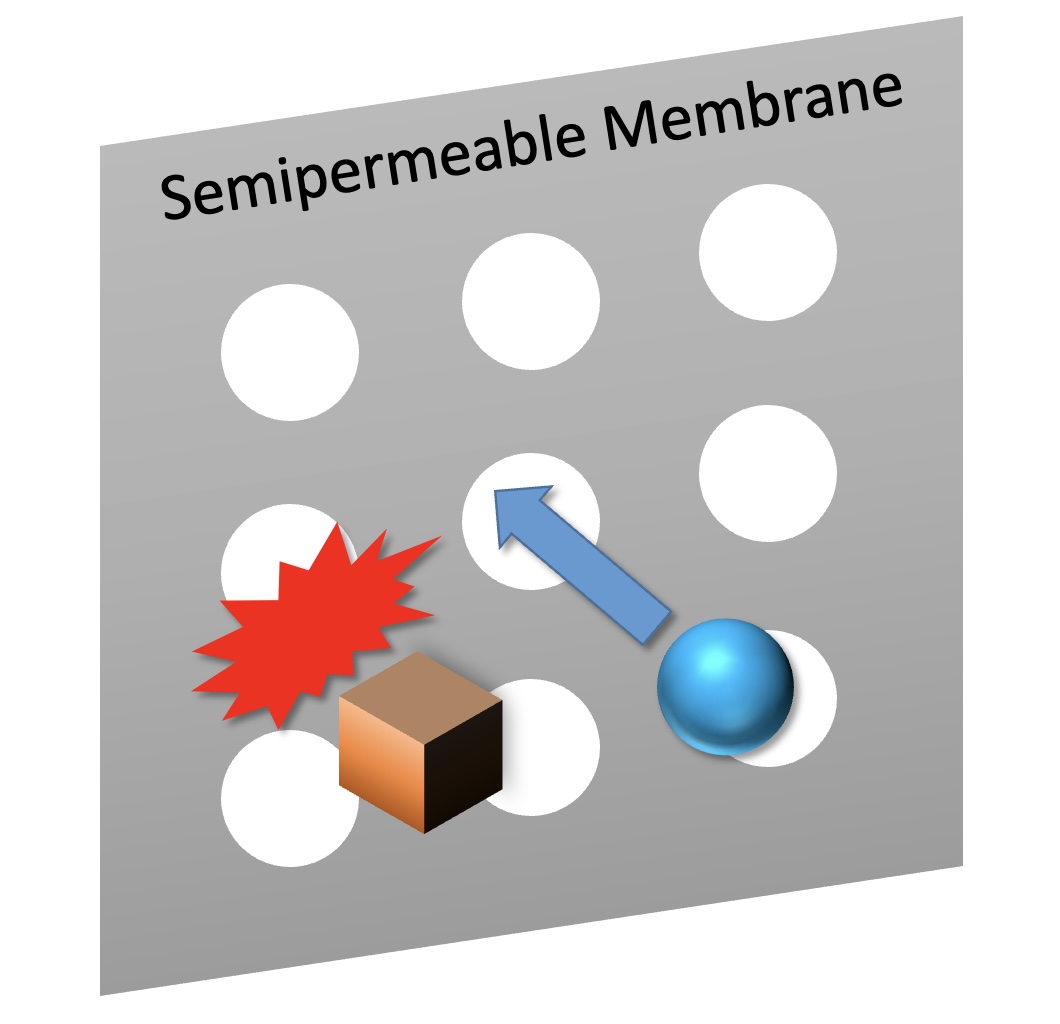
How much would you bet against Maxwell’s Demon?


I didn’t know well how to begin this post, and I also wanted to give these bots a try, so I’ve got the picture above from LensGo and I’ve asked chatGPT to generate a short story about Dr. Spock gambling against Maxwell’s Demon. Here it is:

Dr. Spock, the renowned physicist, found himself in an unexpected predicament. Across the green-felted table in a high-stakes casino, he faced an unlikely opponent: Maxwell’s Demon, a quantum-imbued entity known for challenging the laws of thermodynamics.
Their game wasn’t the usual casino fare. Instead, they wagered on the concept of dissipated work and energy. Dr. Spock, guided by the principles of scientific rationality, made precise calculations. Maxwell’s Demon, with a mischievous glint in its eye, played the odds.
As the final bets were placed, the cards were revealed, and the roulette wheel spun. In the end, it was Dr. Spock’s logical deductions that won the day, while Maxwell’s Demon learned that even in its magical universe, the laws of thermodynamics held sway. With a nod of acknowledgment, the demon vanished into the enigmatic folds of uncertainty, leaving Dr. Spock to ponder the intersection of science and chance.

Meh. Not super impressive… And why Maxwell’s Demon should be “quantum-imbued”? I didn’t prompt for anything quantum…

Anyway, this was to introduce a paper that we recently published in Physical Review Letters (paper freely available on the arXiv), discussing the second law of thermodynamics and Crooks’ fluctuation relations from the point of view of expected utility theory (EUT), which is what economists use to model betting strategies and rational agents.

The punchline is that all Rényi divergences between forward and backward process have the exact operational interpretation of how much a rational betting agent, with risk aversion r=𝛼-1, would be willing to pay to avoid betting on the performance of a stochastic thermal engine. In EUT jargon, this is called the certainty equivalent value. Thus, for example, the conventional relative entropy (𝛼=1) is not only the usual average dissipated work, but also the certainty equivalent amount for a perfectly rational agent (like the Spock in the picture…) who is neither risk-seeking nor risk-averse (r=0). Instead, for an infinitely risk-averse player (𝛼=r=∞), who cannot tolerate any uncertainty and simply wants to walk away from any possible gamble, the certainty equivalent amount naturally corresponds to the worst-case scenario of maximum dissipated work, as measured by Dmax, thus recovering a result of Yunger-Halpern et al. We are also able to describe the zoology of extremely risk-seeking, happy-go-lucky gamblers with r<-1 (𝛼<0), although the corresponding certainty equivalent amount is no longer a properly defined Rényi divergence.

We had fun with this paper: putting Maxwell’s Demon and economics together makes for a lot of jokes… Speaking of which, here is one by the bot:

Why did Maxwell’s Demon decide to walk into Wall Street?

Because he heard there was a hot market for sorting bull and bear markets!

OK, bot, nice try…

Say hello to von Neumann’s “other” entropy…

alias observational entropy!

In his 1932 book, von Neumann famously discusses a thermodynamic device, similar to Szilard’s engine, through which he is able to compute the entropy of a quantum state, obtaining the formula S(\rho)=-Tr[\rho\log\rho]. I discussed about this in another post.

Probably less people know however that, just a few pages after having derived his eponymous formula, von Neumann writes:

Although our entropy expression, as we saw, is completely analogous to the classical entropy, it is still surprising that it is invariant in the normal (note added, in the sense of “unitary/Hamiltonian”) evolution in time of the system, and only increases with measurements — in the classical theory (where the measurements in general played no role) it increased as a rule even with the ordinary mechanical evolution in time of the system. It is therefore necessary to clear up this apparently paradoxical situation.

What von Neumann is referring to in the above passage is the phenomenon of free or “Joule” expansion, in which a gas, initially contained in a small volume is allowed to expand against the vacuum, thereby doing no work, but causing a net increase in the entropy of the universe, even though its evolution is Hamiltonian, i.e., reversible, all along.

In order to resolve this issue, von Neumann suggests that the correct quantity to consider in thermodynamic situations is not (what we call it today) von Neumann entropy, but another quantity, that he calls macroscopic entropy (and which today is called observational entropy):

S_M(\rho)=-\sum_ip_i(\log p_i-\log V_i)

where M denotes a fixed measurement, i.e., a POVM \{M_i\}_i, p_i=Tr[M_i\ \rho] is the expected probability of occurrence of each outcome, and V_i=Tr[M_i] are “volume” terms. The measurement, with respect to which the above quantity is computed, is used by von Neumann to represent, in a mathematically manageable way, a macroscopic observer “looking at” the system: the system’s state is \rho, but the observer only possesses some coarse-grained information about it, and the amount of such coarse-grained information is measured by the macroscopic entropy.

In a paper written in collaboration with Dom Safranek and Joe Schindler and recently published on the New Journal of Physics, we delve into the mathematical properties and operational meaning of observational/macroscopic entropy, and discover some deep connections with the theory of approximate recovery and statistical retrodiction, which is a topic that keeps showing up in my recent works, even if I’m not looking for it from the start.

Is it perhaps because retrodiction really does play a central role in science? Or is it just me seeing retrodictive reasoning everywhere?
Identifying in the second law of thermodynamics the logical foundation of physical theories

Arthur Eddington once famously wrote: “If your theory is found to be against the second law of thermodynamics, […] there is nothing for it but to collapse in deepest humiliation.” So why not take the second law as an axiom, on which physical theories are built, rather than as a consequence to be tested? The problem is that, in its conventional thermodynamic formulation, the second law relies on quite a lot of physics to have been already introduced, and it is not clear how one could assume its validity before other concepts like “work” or “heat” are even defined.

In a paper published today on Physical Review Research, we identify in von Neumann’s information engine the conceptual device that allows us to discuss the second law already from the early stages of the construction of a physical theory, when its most fundamental logical structures are being laid down. What we find is that, by concatenating two information engines in a closed cycle, the second law can be thought of as the requirement that no information can be created from nothing, thus guaranteeing the internal logical consistency of the theory.

All work and no play makes Maxwell’s demon tired

From the popular summary of my paper with Arshag and Mark, “Thermodynamic constraints on quantum information gain and error correction” just published on PRX Quantum.

It is now widely accepted that Maxwell’s demon does not, in fact, break the second law of thermodynamics, if the energetic cost of resetting its memory is taken into account. This resolution of the paradox is known as Landauer’s principle.

Landauer’s principle is only the limiting case of a more general triple trade-off relation between the thermodynamic, information-theoretic, and logic performances of the demon.

In this work, we delve into the inner workings of Maxwell’s demon by considering how it behaves in the quantum error correction setting. We show that Landauer’s principle is only the limiting case of a more general triple trade-off relation between the thermodynamic, information-theoretic, and logic performances of the demon. For example, we show that for most measurements that the demon can perform, extracting work above the Carnot limit is penalized by a drop in the error correction fidelity. Moreover, when the demon successfully performs perfect error correction, work extraction above the Carnot limit becomes impossible with most quantum measurements. Finally, we realize that the amount of information that the demon can extract about the error type is bounded from above by the dissipated heat during that process. Interestingly, this also gives physical meaning to negative values of this information gain.

The meaning of “Quantum Quia”

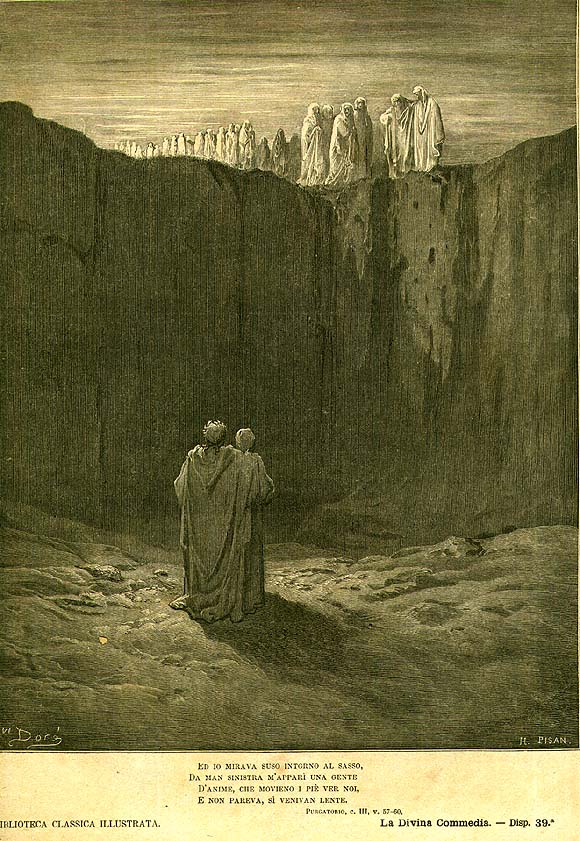
I take the opportunity of the 700th anniversary of Dante‘s death to explain the meaning of this blog’s name.

Illustration by Gustave Doré.

In Dante’s Purgatorio, Canto III, Virgil warns Dante about the limits of human intellect, which is able to understand and describe relations between events (the quia, Latin for “because/for”), but not the events’ “true reality”.

Fast forward to the 21st century, I believe that this viewpoint is close in spirit to the idea, which I’m very fond of at present, that the deepest laws of physics tell us more about our “learning mechanisms” than they do about “reality” (whatever that means).

Here is the excerpt from Dante’s Purgatorio, Canto III, verses 37-45:

“State contenti, umana gente, al quia,
che se possuto aveste vedere tutto
mestier non era parturir Maria;
e disiar vedeste sanza frutto
tai che sarebbe lor disio quetato,
ch’etternalmente è dato lor per lutto:
io dico d’Aristotile e di Plato
e di molt’altri”; e qui chinò la fronte,
e più non disse, e rimase turbato.

The same excerpt in English:

“Mortals, remain contented at the quia;
For if ye had been able to see all,
No need there were for Mary to give birth;
And ye have seen desiring without fruit,
Those whose desire would have been quieted,
Which evermore is given them for a grief.
I speak of Aristotle and of Plato,
And many others;” and here bowed his head,
And more he said not, and remained disturbed.

Postdoc position available

Position title and duration: postdoc or research assistant professor, depending on the candidate’s qualifications. The appointment is offered initially for a one-year period, with the possibility of further extensions up to three years of total duration.

Description: this position is offered by the Quantum Information Theory Group within the collaboration “Extreme Universe”, headed by Prof. Tadashi Takayanagi (YITP, Kyoto University). This collaboration brings together Japan-based world-renowned researchers in quantum information theory, quantum gravity, cosmology, and condensed matter physics, with the aim of creating new and exciting bridges between these very active areas of research. The successful candidate will work in close contact with Prof. Francesco Buscemi (Nagoya University), but is expected to interact also with the rest of the collaboration group and to participate in various interdisciplinary meetings within the project. The successful candidate is expected to commence their appointment on April 2022 or as soon as possible after that.

Requirements: applicants are expected to hold a PhD degree in a theoretical field related to quantum information sciences by the time they begin their appointment. Ideally, they will be familiar with recent ideas and techniques in quantum information theory and have at the same time strong interests in fundamental questions in theoretical physics.

Submission procedure: interested candidates should provide

  1. a cover letter;
  2. an up-to-date curriculum vitae;
  3. a research statement;
  4. an up-to-date list of research achievements (including published papers, preprints, talks, posters, etc.);
  5. contact information of three references able to provide recommendation letters upon request.

The application can be done by sending the above documents directly to buscemi@nagoya-u.jp or through the project’s webpage at https://academicjobsonline.org/ajo/jobs/19880 (where also other openings are advertised)

Submission deadline: 30 November 2021

For further inquiries, please contact me at buscemi@nagoya-u.jp